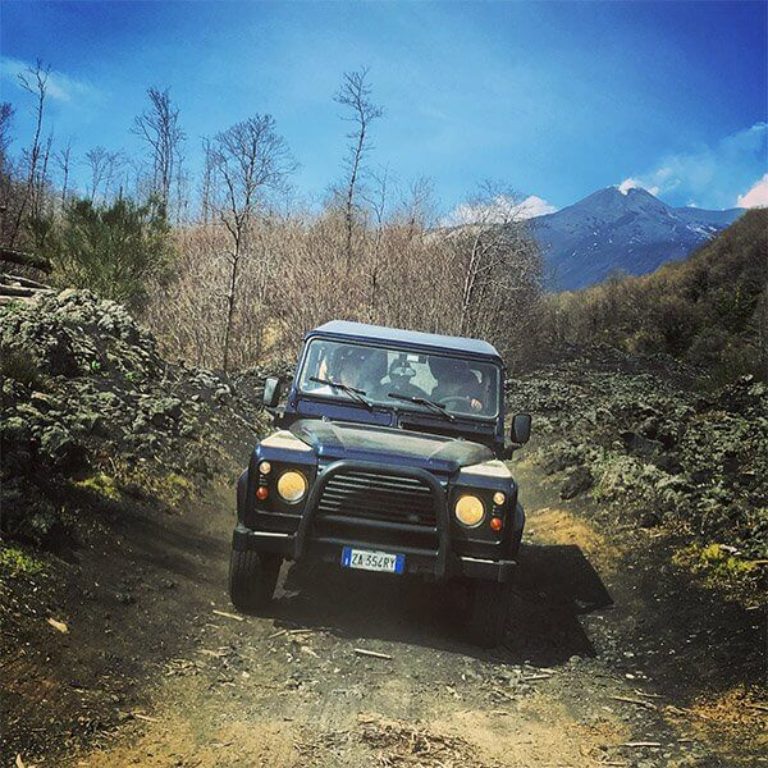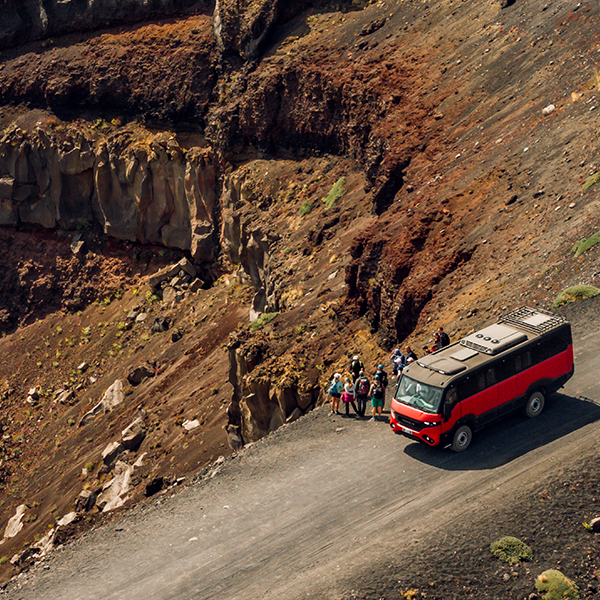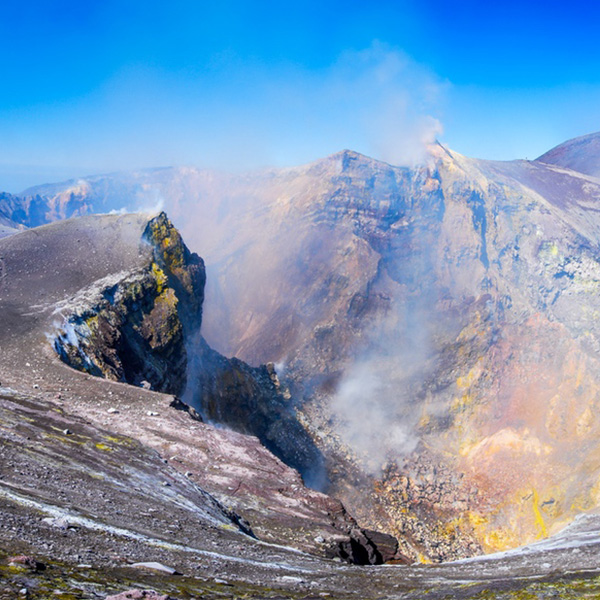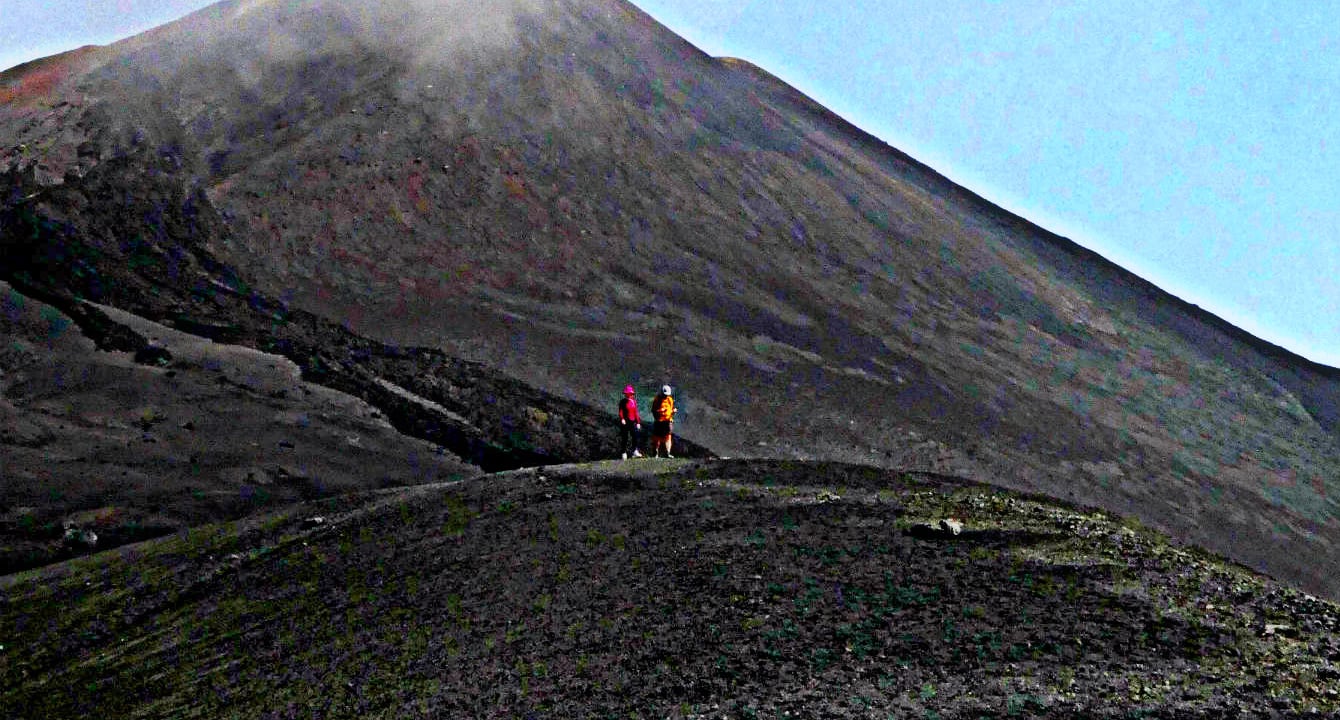
At first, you might not even recognize them… They blend into the group—sometimes even appearing like the “black sheep,” aloof or keeping to the background. Then, suddenly, they step away from the rest, climb onto a boulder or an embankment, and begin to share wonders. These are mountain guides—or, more precisely in our case, Mount Etna’s guides. They don’t have a single, uniform look: some may have white hair, others long red locks; some may have weathered, wrinkled faces, while others look as fresh-faced as teenagers. What truly matters, however, is their ability to make you dream big.
Mountain guides or volcanological guides?
Mount Etna is a volcano. So, are the guides who work here mountain guides or volcanological guides? Actually, they can be both, because Etna is, first and foremost, a mountain—and, at the same time, an active volcano. A mountain guide is a qualified professional trained to lead and instruct others across any type of mountain terrain … meadows, rock faces, snow, or ice … and they typically possess expertise in botany, meteorology, and geology. They are often also skilled in sports such as skiing, climbing, and trekking.
A volcanological guide is a mountain guide who has specialized in leading groups on active or dormant volcanoes and through lava tubes. Volcanic terrain differs from that of a typical mountain, requiring the guide to be able to identify potential hazards at every step. They must be experts in geology and volcanology, and they must monitor the weather, not just for sudden shifts in conditions, but also to identify safe vantage points from which to observe an eruption. High-altitude winds, for instance, can carry ash and volcanic debris, so it is essential to know how to steer clear of them.
 Etna Guides: a not so ancient history
 Etna Guides: a not so ancient history
The first guided excursions on Mount Etna appear in the accounts of travelers from the 18th century on. Far less developed than it is today, the mountain was then a wild landscape, devoid of signposts or established trails; consequently, visitors relied primarily on local residents (carters, hunters, shepherds, and farmers). The most skilled guides were almost exclusively people from Nicolosi, which was, at the time, the most significant hub in the foothills of Etna. In 1776, a French traveler wrote of a “Cyclops” who accompanied him along the volcano’s paths … likely, a local shepherd named Biagio Motta, a tall, robust man who bore that very nickname.
Around the turn of the 18th and 19th centuries, naturalist Dr. Mario Gemellaro gained renown in Nicolosi. He specialized in the flora native to the Etna region, and while out searching for specimens, he would often accompany passing visitors. Under his guidance, a group of shepherds and muleteers formed what would become the very first group of mountain guides for Etna. This was in 1804. To work with Gemellaro and his brother Carlo’s group, one had to learn everything about the local plants and trails, while also demonstrating honesty and loyalty in the face of danger.
In 1875, the Sicilian branch of the Italian Alpine Club (CAI) was founded in Catania. Just two years later, the first official regulations for the training of “mountain carriers” were introduced, and the groups organized by the Gemellaros were among the first to be enlisted. Since then, the task of training mountain guides has fallen to the CAI and similar associations (such as AIGAE). A specialized category exists for “volcanological guides,” who must complete dedicated courses in addition to their foundational training.
Guides today
Today, the profession of a mountain or volcanological guide—much like that of a hiking guide—is relatively unregulated. Unlike traditional tourist guides, these professions are not governed by national state examinations. Instead, individuals undergo specific training through professional associations, have their skills assessed via practical exams, and receive a license that allows them to work independently.
Competition is extremely high, making it challenging to break into the field; however, those who succeed can be certain they have the best job in the world. Working as a guide on a volcano like Mount Etna also carries a great deal of responsibility, as tourists are entirely vulnerable in the face of the volcano and must rely on their guides—even in the event of an eruption. Guides on Mount Etna must constantly collaborate with geologists from the INGV (National Institute of Geophysics and Volcanology) to assess the safety of the routes.
Unforgettable guides and new generations
Among the key figures in the first group of professional guides were Antonio Contarino … who was appointed head of the “Etna Guides” … along with Giuseppe Gemmellaro, Antonino Carbonaro, and Salvatore Consoli.
It was not until the 20th century that an exceptional figure emerged: Antonio Nicoloso (1933–2007), regarded as one of the most legendary guides of Mount Etna. A profound expert on the volcano, he dedicated his life to exploring it and sharing knowledge about its characteristics. On September 24th, 1974, he accomplished an extraordinary feat: he became the first person to descend into the Central Crater for scientific purposes, using a wooden ladder and ropes. Another significant name from the last century is Francesco Emmi, a mountain guide who has been active on Mount Etna since 1975, having spent decades leading excursions and facilitating experiences on the volcano.
Today, alongside highly experienced professionals, new generations of alpine and volcanological guides—such as Vincenzo Greco and Filippo Greco—are at work, combining family tradition, scientific training, and deep local knowledge. Another well-known and beloved figure in more recent times is Fabrizio Zuccarello; with his carefree, “pirate-esque” style, he even founded a Facebook page “Etnative-Visit Etna.”
And, of course, there is also us … Go Etna! , with our well-trained, multilingual guides who can lead you not only up Mount Etna but also through the surrounding areas to discover mountains, streams, villages, and monuments. With us, you can choose how to travel … on foot or by motorized vehicle, including even a helicopter! Simply visit our website and take your pick!
How to contact the guides
The best way to get in touch with Etna guides today is to ask at the hotels and B&Bs in the towns at the foot of the volcano; they are almost always well-informed about who provides the best services in this field. There are also professional associations with their own dedicated websites.