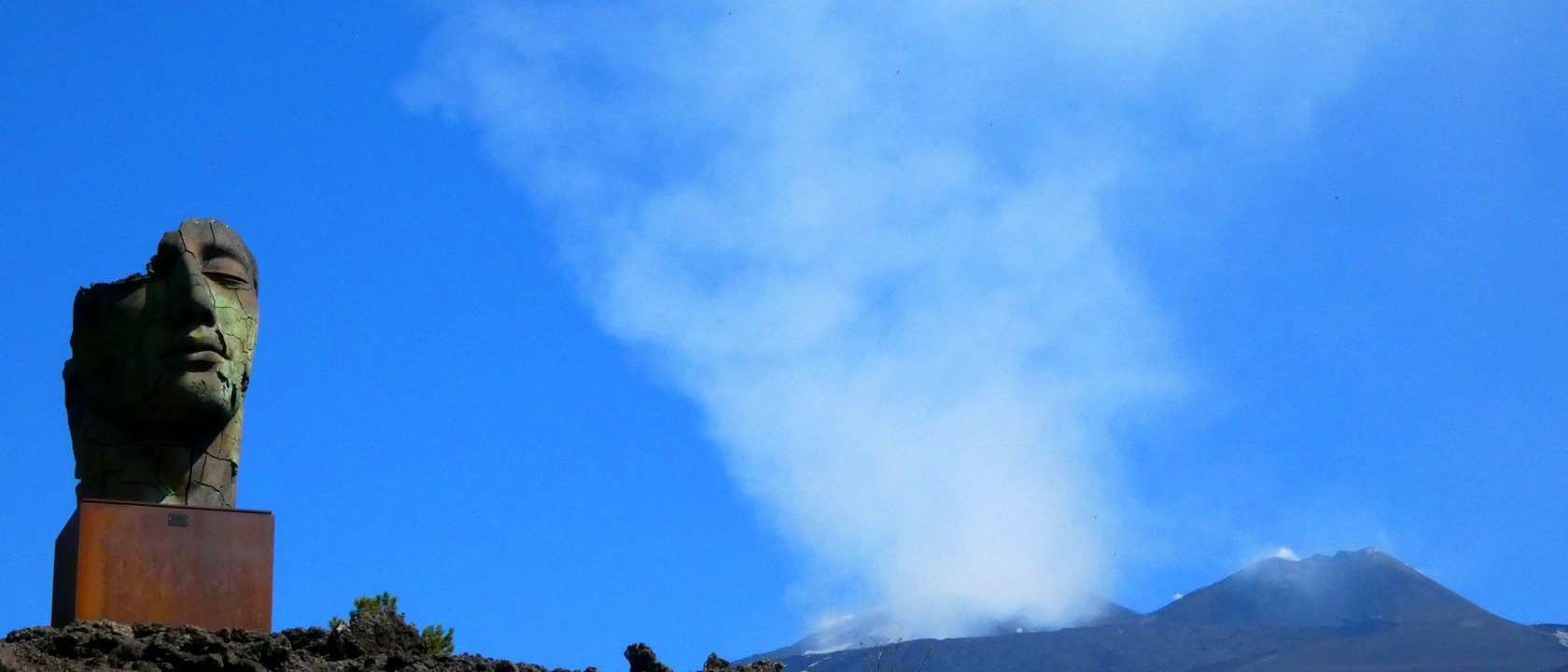
Igor Mitoraj’s Cracked Theseus “arrived” on Mount Etna in March 2024. It was part of a traveling exhibition conceived by the renowned Polish artist and sculptor – who passed away in 2014 – which involves installing his distinctive, monumental sculptures in various high-profile tourist destinations. These are “loans”, temporary displays that, after a certain period, move on to other locations or museums. The Theseus was no exception. It was intended to remain on Mount Etna for only a few months … maybe a year (the exhibition was scheduled to end in October 2025) … yet it stayed until yesterday, November 27, 2026. A crane lifted it from its temporary home, the lava field above Ragalna and a spectacular vantage point offering views of both the coast and the volcano …. and a fairy tale came to an end.
Controversy at the arrival, controversy at departure
Upon its arrival, the Theseus was met with a chorus of criticism. What was this absurd object … with its half-green, cracked face … doing in such a wild, entirely natural landscape, just steps from the entrance to the Filiciusa-Milia trail on the southern slope of Mount Etna? Who had dared to place this “thing” (what an eyesore!!) right in front of the view of the craters?
Over time, however, the Cracked Theseus became part of that natural environment. In its own way, it was, after all, a piece of nature itself. It witnessed the most spectacular eruptions alongside us, posed for our photos beneath the Milky Way at night, and endured extraordinary snowfalls, earthquakes, and even the heavy storm “Harry”. Now that it is leaving – as is it had to – a new chorus of controversy has erupted, perhaps from the very same people who once criticized it; for it has become impossible to imagine that landscape without this “friend.”
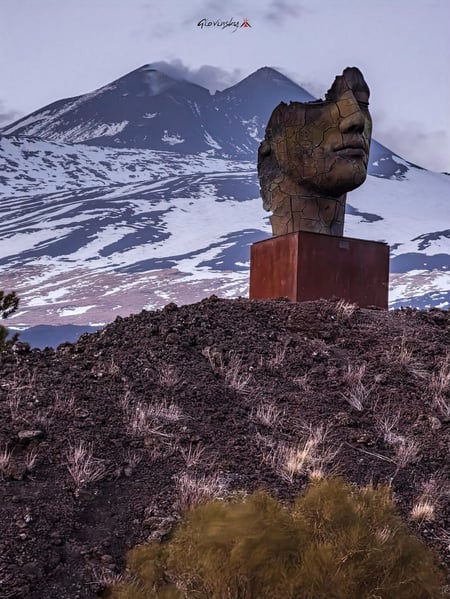
Yet, Theseus … with his impassive air and smiling silences … ought to have taught us the invaluable lesson of “non-violence”. And this contentious country has failed to learn it. We quarrel over everything, about everything, with everyone, forever forming “factions” armed against one another. We have understood nothing of this raw yet beautiful statue, which faced every adversity with its “bronze face” and the steadfastness of one who has no need to shout in order to command presence.
Attempts to keep it and deep disappointment
It seems that, recently, efforts were made to keep Theseus on Mount Etna. Negotiations were underway to purchase the statue and leave it there permanently. Something went wrong – or perhaps, once again, our way of handling things has proven disappointing.
Mr. Luca Pizzi, the curator of the Mitoraj exhibition, expressed bitter sentiments regarding this departure, as reported by Etnanews24: “Mitoraj loved Sicily dearly; that is, in part, why we prioritized the island for our exhibition projects. The outcome, however, is disheartening: Ragalna represents an incomprehensibly missed opportunity. The exhibition in Syracuse – which, at the time, was the most significant display of monumental sculpture in Europe – was effectively ignored by the very institutions that had requested it. Furthermore, the Icaria Grande stood for 18 months in Ortigia, next to the Castello Maniace, without any nighttime illumination. Then I think of the other works in Sicily, and the state they were in when I last visited them. A heritage of art and beauty treated with inexplicable neglect … a lack of respect that both surprised and saddened us, and which raises many questions to which we can find no answer.”
At this point, no… all the more reason why the Theseus cannot remain. It must go on to have other experiences that might, perhaps, value it more.
We will miss it but we must let it go
And what about us … citizens, tourists, and those who simply enjoy the trails of Mount Etna? Will we miss the green, larger-than-life face of Theseus?
Personally (if you’ll allow me a small, intimate confession), I will miss him a great deal. Theseus appeared on one of my favorite trails a month after my father passed away; I brought my family up there during our time of deepest grief, and that statue managed to bring us unexpected smiles and moments of happiness. So many of us captured it in our photos, our selfies, our toasts with friends, and against the backdrop of sunsets … of course, we grew quite fond of “him”.
But, just as with loved ones who fly off toward their own dreams, we must learn to let go. We should take all the beauty this experience has given us and wish our “own” Theseus even more magnificent stages elsewhere. What remains for us is the pristine beauty of Mount Etna … our other, deeply beloved giant … which is still ours. At least, as long as we know how to protect it from those who would carve it up and privatize it for the benefit of a wealthy few. Theseus taught us that the landscape itself, Mount Etna, is what matters most; it is what remains with us, and it is what we must always defend.
Who was Igor Mitoraj?
Igor Mitoraj (1944–2014) was one of the most significant contemporary sculptors, renowned worldwide for works inspired by classical Greek and Roman art. Born in Oederan, Germany, to Polish parents, he spent much of his life between Poland, France, and Italy.
After studying at the Academy of Fine Arts in Krakow, he moved to Paris, where he began to focus on sculpture. Later, he chose Pietrasanta, in Tuscany, as his preferred location for working with marble and bronze. His works frequently depict human figures – faces, busts, and bodies – inspired by classical mythology. A distinctive feature of his sculptures is the presence of missing elements, fractures, and weathered surfaces, reminiscent of ancient statues discovered at archaeological sites. Through these imperfections, Mitoraj sought to express the fragility of human existence, the passage of time, and the beauty of memory.
His monumental sculptures are exhibited in major cities and significant artistic venues around the world. In Italy, some of his works can be seen in the Valley of the Temples in Agrigento, where they blend harmoniously into the archaeological landscape. Igor Mitoraj has left behind an extraordinary artistic legacy, one that bridges the past and the present, the classical and the modern. (PHOTOS BY G MUSUMECI AND GIOVINSKY)